
Quick answer
Estimates go cold after the first conversation because the customer's buying process often continues after the contractor sends the quote. The customer may be comparing other companies, thinking about the price, waiting to speak with a spouse or property owner, looking for financing, or trying to understand the scope of work.
For contractors, the problem is that silence is often treated as a dead lead. In reality, silence can mean many things. The customer may still be interested, but if there is no structured follow-up, the opportunity slowly disappears without a clear yes, no, objection, or next step.
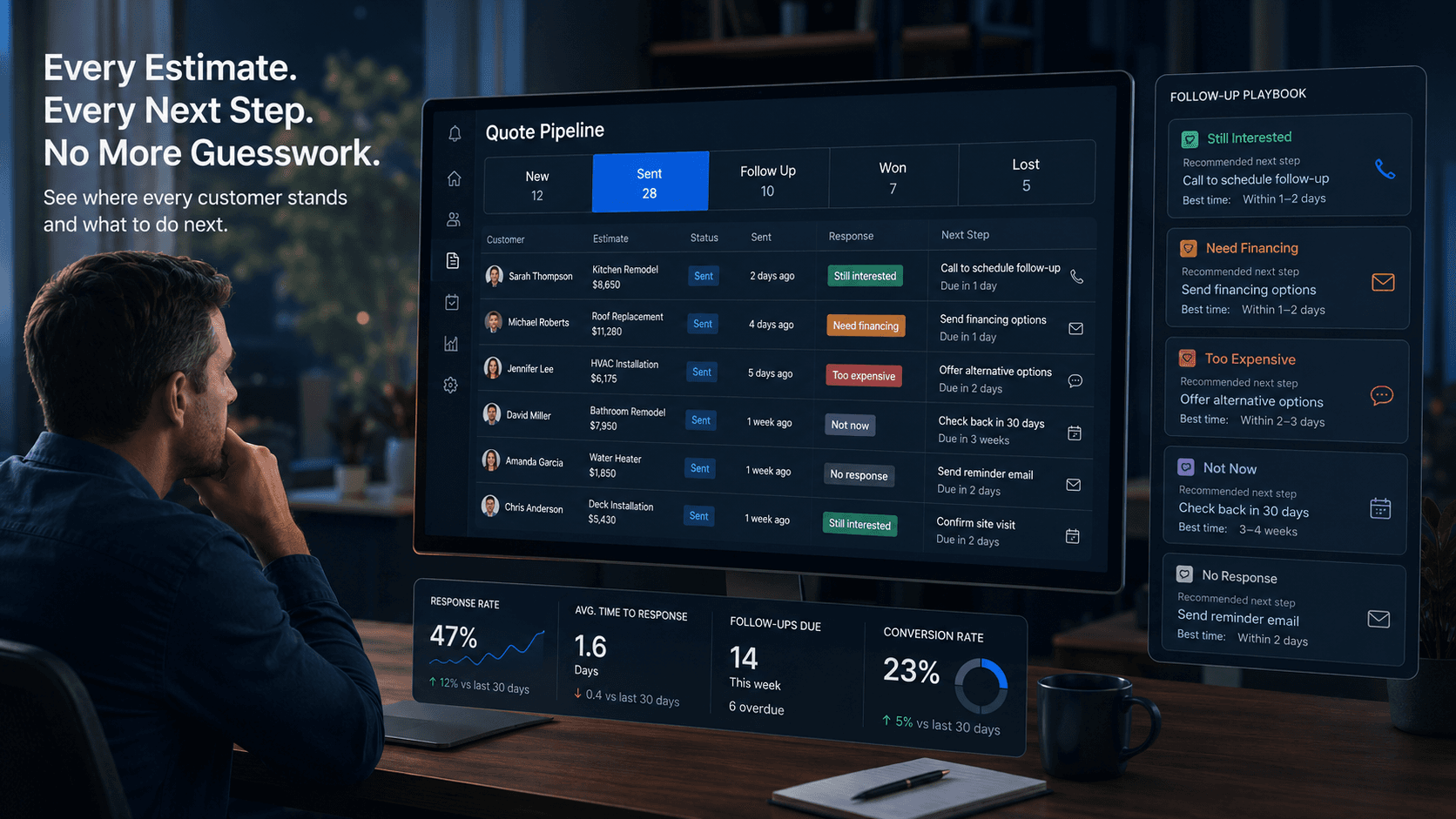
A strong contractor estimate follow-up process should make sure every sent estimate has a follow-up date, assigned owner, CRM status, response path, and next action. The goal is not to pressure customers. The goal is to keep good opportunities visible and prevent quote ghosting from becoming normal.
This is where estimate follow-up automation, CRM cleanup, and better owner visibility can help home-service businesses reduce silent estimates and improve the workflow between quote sent, customer response, booking, nurture, or close-lost.
What it means when an estimate goes cold
An estimate goes cold when the contractor has already had the first meaningful conversation with the customer, but the opportunity stops moving forward after the estimate is sent.
This can happen after a phone call, website inquiry, inspection, site visit, service diagnosis, sales conversation, or proposal meeting. The customer showed some level of interest. The contractor spent time gathering information, preparing pricing, and sending the quote. Then the customer stops replying.
Contractors often describe the problem this way:
"Spending time on quotes for customers that never reach back out."
In contractor discussions, this pain often sounds like:
"No yes. No no. No objection. Just nothing."
That silence is frustrating because the contractor does not know what happened. The customer may have chosen another company, but they may also still be considering the quote. They may have a price concern, a scope question, a financing need, or an internal decision-maker slowing things down.
The estimate is not always lost. But without a follow-up workflow, the business has no reliable way to find out.
Why estimates go silent after the first conversation
Estimates usually go silent for practical reasons, not always because the customer lost interest. Many homeowners and property managers are not ready to make a decision immediately after receiving a quote.
They may be comparing other quotes. They may need to check their budget. They may need to discuss the decision with someone else. They may be unsure about the scope. They may have questions they do not know how to ask. They may be waiting for timing, financing, approval, or a second opinion.
One common contractor frustration is:
"They said they were interested, then disappeared."
That is exactly why follow-up needs structure. The first conversation does not complete the sale. It starts the decision process.
For home-service businesses, this matters across many trades. HVAC estimate follow-up may involve replacement options, maintenance plans, financing, or urgency around comfort. Roofing estimate follow-up may involve insurance, storm damage, material options, and property-owner approval. Plumbing estimate follow-up may involve repair versus replacement decisions, water heater options, or budget concerns. Electrical and solar estimates can involve scope questions, financing, utility details, or long-term ROI concerns.
Each of these situations requires more than "just checking in."
What research says about estimate follow-up and customer decision-making
The problem of cold estimates is not only a contractor problem. It reflects how modern customers make buying decisions.
Customers often compare options before hiring a contractor. The Better Business Bureau advises homeowners to gather multiple quotes because contractor bids can vary and should be compared using the same criteria. That means a customer going quiet after receiving your estimate may not be ignoring you. They may be reviewing other bids, comparing scope, checking trust signals, or trying to understand why one quote is different from another.
The Federal Trade Commission also advises homeowners to check contractor credentials, reviews, complaints, insurance, and recommendations before hiring. This matters because the estimate decision is not only about price. The customer may be asking, "Can I trust this company?" "Is the scope clear?" "Is this contractor properly qualified?" "Do I understand what I am paying for?" If the follow-up does not address those concerns, the customer may delay or move on.
Salesforce customer engagement research also points to the importance of trust, responsiveness, personalization, and digital-first expectations in customer relationships. For contractors, that means the estimate follow-up experience is part of the buying decision, not an afterthought.
Research on online sales leads has also shown that response speed matters. Harvard Business Review's "The Short Life of Online Sales Leads" found that companies often fail to respond fast enough to online inquiries, even though quick response improves the chance of reaching and qualifying a lead. For contractors, the lesson is simple: if an estimate or quote inquiry enters the business, the next step cannot depend only on memory or manual checking.
Industry-specific data points in the same direction. Jobber's 2026 Home Service Trends Report highlights how quote conversion, lead response, and operational systems affect home-service business performance. The practical takeaway is that estimate follow-up should be visible, structured, and tracked instead of handled casually.
This is why estimate follow-up should not be treated as a casual reminder. It should be part of the contractor's revenue workflow. A sent estimate should have a follow-up date, assigned owner, response category, CRM status, and next action. Otherwise, the business cannot tell whether the customer is lost, undecided, confused, price-sensitive, waiting on approval, or still a good future opportunity.
Silence does not always mean the customer is lost

A silent estimate is not automatically a dead estimate. This is one of the biggest mistakes contractors make.
Some customers are still interested but need time. Some are waiting for another quote. Some are confused. Some are embarrassed to say the price feels high. Some are trying to get approval from a spouse, landlord, manager, or property owner.
Home-service owners often describe the pain as:
"Some people are still interested, but they need financing or time to decide."
If the business treats every silent estimate the same way, the follow-up becomes weak. The office may send one generic reminder, then stop. The estimate may sit in the CRM with no next action. Eventually, the opportunity disappears.
A better approach is to treat silence as unknown, not as lost.
The follow-up should try to identify the reason for silence. Is the customer still interested? Do they need clarification? Is the price the issue? Are they waiting on approval? Do they want a different option? Should they move into nurture instead of being abandoned?
Silent estimates need diagnosis. Without that diagnosis, the business is guessing.
This is one reason estimate follow-up is part of the larger pattern behind why home-service companies lose leads even when they are getting enough inquiries.
Price concerns need a different follow-up path

Price is one of the most common reasons estimates go cold. But many customers do not say "too expensive" directly. They simply stop responding.
That creates a problem for the contractor. If price is the issue but the follow-up message only says "Just checking in," the customer has no easy way to continue the conversation.
Price concerns should have their own follow-up path.
For example, the business may need to clarify what is included in the estimate, explain the difference between repair and replacement, offer a phased option, ask whether the customer is comparing quotes, or discuss payment options where appropriate.
This does not mean discounting every quote. Discounting too quickly can damage margins and train customers to negotiate by disappearing.
The goal is to understand the objection. A customer who thinks the quote is expensive may still value quality, warranty, speed, communication, materials, or financing. But if the contractor does not follow up properly, that conversation never happens.
A good home service quote follow-up process should make it easy to route price objections differently from no-response quotes.
Financing questions should not be treated like normal follow-up

Financing questions are not the same as general interest. If a customer asks about financing or payment options, that is a buying signal that needs specific handling.
Many larger home-service projects involve real budget decisions. HVAC replacements, roofing projects, solar installations, electrical upgrades, plumbing replacements, and remodeling-related work can all require more than a simple yes or no.
If financing questions are handled slowly or casually, the customer may lose confidence or choose a company that makes the payment process clearer.
A financing-related estimate should have a clear next step. That may include sending financing information, explaining available options, routing the customer to the right person, setting a follow-up date, or marking the quote in the CRM so it does not get treated like a normal silent estimate.
When financing interest is buried inside notes, text messages, or someone's memory, it becomes easy to miss. This is why CRM follow-up for contractors should include response categories, not just broad stages like "estimate sent."
Decision-makers often slow down the quote process
Not every customer can approve the job alone.
A homeowner may need to talk with a spouse. A tenant may need landlord approval. A property manager may need owner approval. A commercial contact may need a manager, board, or finance person to review the estimate. A roofing or solar project may involve insurance, lending, or utility-related steps.
When another decision-maker is involved, the estimate may go silent even though the lead is still alive.
The follow-up should reflect that reality.
Instead of asking only, "Are you ready to move forward?" the contractor can ask whether another person needs information, whether a revised estimate would help, or whether the customer needs a simpler explanation of the scope and options.
This matters because many contractors lose momentum after the first conversation. The customer may have liked the technician, trusted the company, and wanted to proceed, but the decision slowed down once another person entered the process.
A strong follow-up workflow should allow the office to mark "decision-maker involved" and schedule the right next action.
Customers may be confused about scope, not uninterested
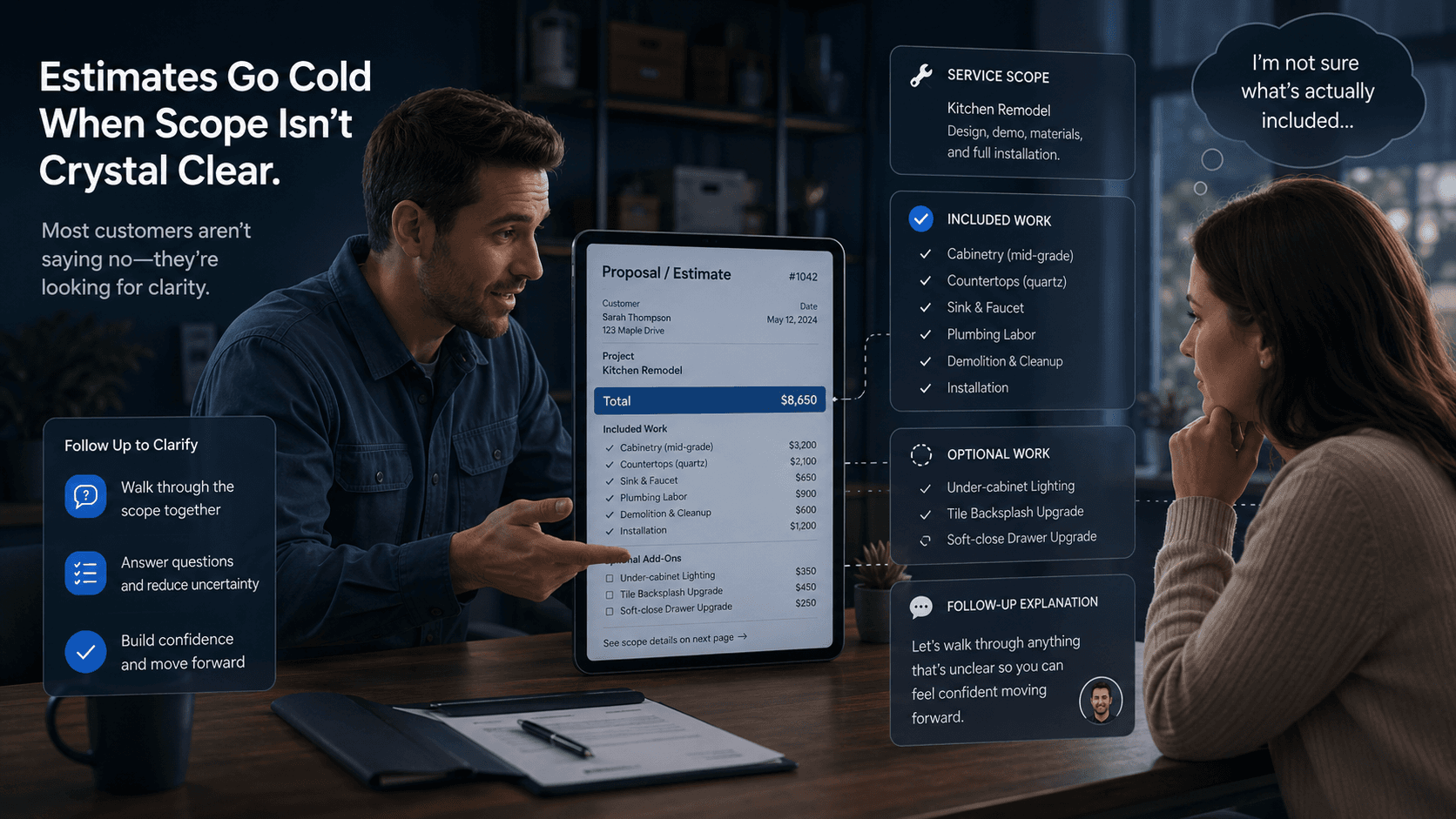
Sometimes the quote goes cold because the customer does not fully understand what they received.
They may not know the difference between repair and replacement. They may not understand why one option costs more. They may not know whether materials, permits, labor, cleanup, warranty, inspection, or follow-up work are included. They may not understand what happens after approval.
This is especially common when the contractor sends a technical estimate without enough explanation.
Customers rarely say, "I am confused about the scope." They often just pause.
That pause can look like disinterest.
This is also why comparing quotes can become difficult for homeowners. If two contractors describe the same project differently, include different materials, explain warranties differently, or format estimates in different ways, the customer may not know whether they are comparing equal options. A clear follow-up call can help the customer understand the scope instead of leaving them to compare price alone.
A better estimate follow-up should make room for clarification. The office or salesperson can ask whether the scope makes sense, whether the customer wants to compare options, or whether they would like a quick call to review the estimate.
When the customer understands the quote, they are in a better position to decide. When they do not understand it, the easiest choice is often delay.
Why manual estimate follow-up breaks as the business grows

Manual follow-up can work when a contractor has a small number of estimates and one person closely tracks every opportunity.
It breaks when volume increases.
More calls come in. More estimates are sent. More jobs are dispatched. More invoices need attention. More customers need updates. The office manager gets pulled into urgent tasks. The owner is busy. Technicians move to the next job.
Eventually, follow-up depends too much on memory.
One common contractor frustration is:
"The quote was sent, but nobody owned the follow-up."
That is the real operational failure. The estimate was not ignored because nobody cared. It was ignored because the workflow did not assign ownership, timing, or the next action clearly enough.
Manual follow-up also makes it difficult to prioritize. A high-value replacement estimate should not be treated the same as a low-fit inquiry. A financing request should not be treated the same as a generic no-response quote. A quote that is one day old should not be treated the same as one that is 30 days old.
As the business grows, the follow-up process needs structure.
Why the CRM should show every estimate's next action
A CRM should do more than store customer records. It should show what needs to happen next.
For contractor estimate follow-up, every sent estimate should have a visible next action. That next action might be a call, email, text, financing follow-up, scope clarification, decision-maker check-in, revised quote, nurture sequence, or close-lost update.
If the CRM only shows that an estimate was sent, the office still has to remember what to do.
That is not enough.
The CRM should help answer:
- Which estimates were sent recently?
- Which estimates have no response?
- Which customers mentioned price concerns?
- Which customers asked about financing?
- Which quotes are high value?
- Which quotes are aging?
- Which quotes need owner attention?
- Which quotes should move into nurture?
- Which quotes should be marked lost?
This kind of visibility helps the owner avoid managing the pipeline through scattered notes, inboxes, text messages, and memory.
You can explore related workflow support on the Services page.
What a quote follow-up workflow should include
A quote follow-up workflow should make sure every estimate moves toward a clear outcome. That outcome does not always have to be a sale. It can also be a no, a future nurture opportunity, a revised scope, a financing path, or a close-lost reason.
A practical workflow should include:
- Estimate sent date.
- Follow-up date.
- Assigned owner.
- Customer response status.
- Quote value or priority level.
- Reason for delay or objection.
- Financing interest.
- Decision-maker involvement.
- Scope questions.
- Next task.
- Owner visibility.
The workflow should also include reminders. If a quote is sent today, there should be a planned follow-up. If the customer does not reply, there should be another step. If the customer says "not now," that should not disappear. It should move into nurture.
Estimate follow-up automation can help with these reminders and routing steps, but the main point is operational discipline. Every sent estimate needs a next action.
Different customer replies need different next steps
Not all customer replies should be handled the same way. A good follow-up process should route the opportunity based on what the customer actually says or does.
Still interested
If the customer is still interested, the next step should be to remove friction. Ask what they need to move forward, offer to answer questions, confirm timing, and make booking or approval easy.
Need financing
If the customer needs financing, send the correct information quickly and assign a follow-up task. Financing interest should be tracked separately because it often means the customer is still serious but needs a payment path.
Too expensive
If the customer says the quote is too expensive, do not immediately discount. First, clarify whether they are comparing quotes, whether they understand the scope, and whether a different option or phased approach makes sense.
Need to talk to someone else
If another decision-maker is involved, offer to send a clearer summary, join a call, or provide a version of the quote that is easier to review. The follow-up should include a specific check-in date.
Not ready yet
If the customer is not ready, move them into nurture instead of letting them vanish. A future follow-up may be appropriate, especially for replacement, maintenance, roofing, solar, or larger project decisions.
No response
If there is no response, the workflow should continue for a reasonable number of touches, then move the estimate into a clear status. No-response quotes should not sit forever as active opportunities.
Went with another company
If the customer chose another company, mark the quote closed-lost and capture the reason if available. Price, timing, trust, financing, scope, or speed can all reveal useful patterns for the business.
This response-path approach is much stronger than sending the same message to every customer.
You can see examples of how workflow paths can be structured in the interactive demo.
Estimate Follow-Up Checklist for Contractors
Use this checklist to review whether estimates are being followed up properly.
- Was the estimate sent and logged in the CRM?
- Does the estimate have a follow-up date?
- Is the customer still interested?
- Did the customer mention price concerns?
- Does the customer need financing or payment options?
- Is another decision-maker involved?
- Does the customer understand the scope?
- Has a follow-up task been assigned?
- Should the quote move to nurture?
- Can the owner see which quotes need attention?
If several of these answers are unclear, the business probably has a quote follow-up problem, not just a sales problem.
How old estimates can move into nurture instead of disappearing
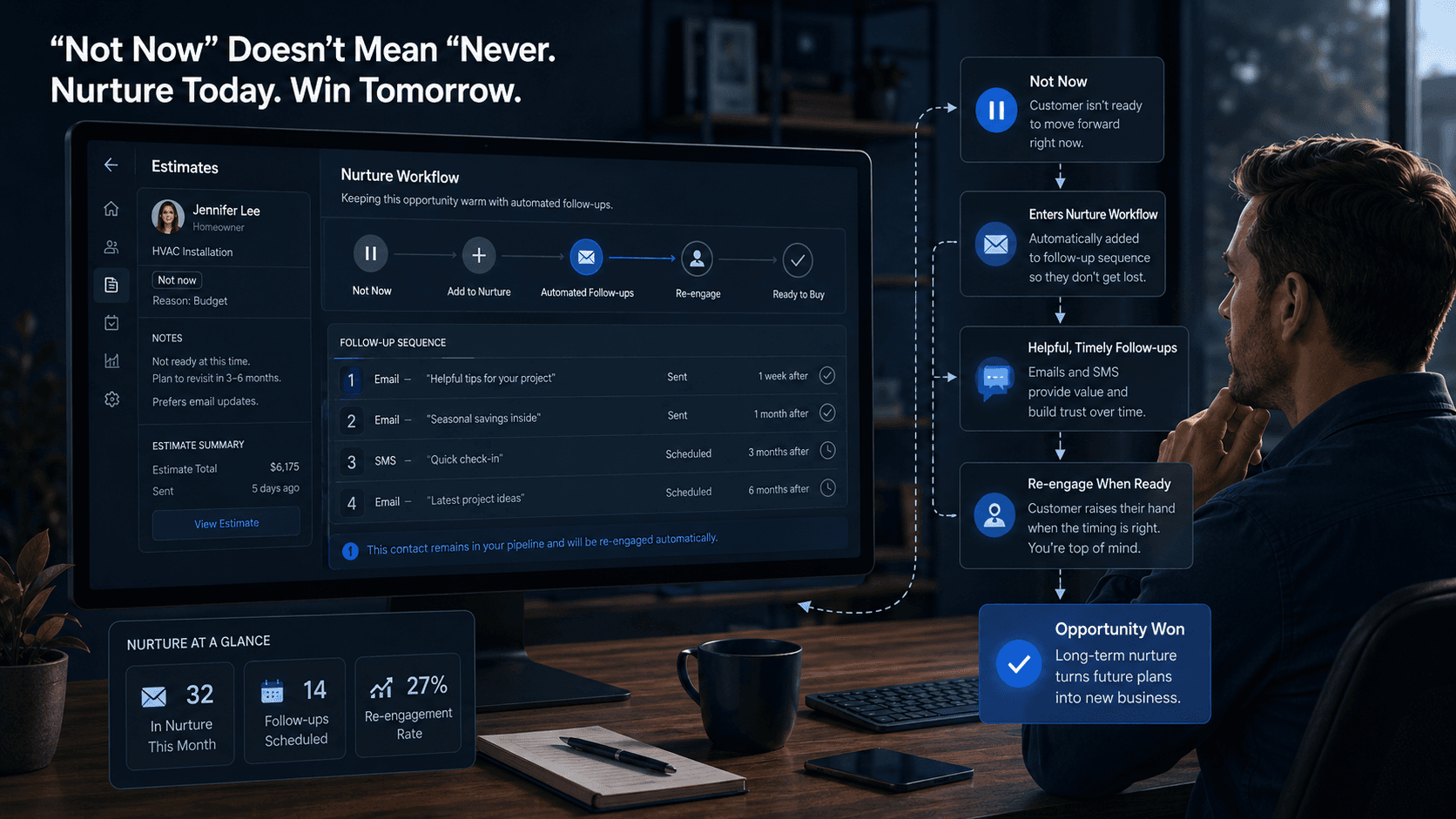
Not every estimate closes quickly. Some customers need weeks or months. Some projects are seasonal. Some customers are waiting for budget, timing, financing, insurance, property approval, or a future trigger.
The mistake is letting those opportunities disappear completely.
Not-now leads should move into nurture. That means the business keeps a clear record of the opportunity and follows up later with useful, relevant communication.
For example, a customer who is not ready for an HVAC replacement may need a maintenance reminder later. A roofing prospect may need a storm-season follow-up. A plumbing customer may need a future replacement check-in. A solar prospect may need more education before deciding.
Nurture should not feel like spam. It should be based on the customer's actual situation.
The key is that old estimates need a status. They should not remain in the CRM as vague open opportunities forever.
How owners can see which quotes still need attention
Owner visibility is one of the most important parts of estimate follow-up.
The owner should not need to ask the office, search the CRM manually, check text threads, and review spreadsheets just to understand which quotes are stuck.
A useful owner view should show:
- Quotes sent.
- Quotes awaiting first follow-up.
- Quotes with no response.
- Quotes with price concerns.
- Quotes needing financing follow-up.
- Quotes involving another decision-maker.
- High-value quotes aging without action.
- Quotes moving into nurture.
- Quotes marked lost and why.
This visibility helps the owner coach the team, spot bottlenecks, and protect high-value opportunities.
For contractors comparing different workflow support options, the Packages page can help clarify which level of support fits the problem.
How RIKU Growth helps contractors with estimate follow-up workflows
RIKU Growth helps home-service companies improve the workflows between inquiries, CRM, booking, dispatch, follow-up, post-job reporting, review capture, proposal workflows, and owner visibility.
For estimate follow-up, that may include:
- Quote follow-up workflows.
- CRM stage cleanup.
- Follow-up task creation.
- Customer response routing.
- Financing request routing.
- Price objection tagging.
- Decision-maker follow-up paths.
- Not-now nurture workflows.
- Owner visibility dashboards.
- Workflow audits to find where estimates are going cold.
RIKU Growth is not a full field-service management software platform. It does not replace Jobber, Housecall Pro, ServiceTitan, QuickBooks, invoicing software, or a complete dispatch system.
Instead, RIKU Growth works as a workflow automation and revenue operations layer around the areas where contractors often lose revenue opportunities.
If your estimates are going silent and nobody can clearly explain why, the first step is not guessing. The first step is to review the workflow.
Want to see which estimates are going cold in your workflow?
If customers are going silent after estimates are sent, the issue may not be only price. It may be response speed, unclear CRM stages, weak quote follow-up, missing financing paths, poor scope explanation, or no owner visibility.
RIKU Growth can review estimate follow-up, CRM stages, quote aging, customer response paths, owner visibility, and nurture opportunities to identify where estimates are getting stuck.
The goal is to make sure every sent estimate has a next action.
Final thought
When estimates go cold, the problem is not always the price, the customer, or the salesperson.
Sometimes the issue is the follow-up workflow.
The customer may still be interested. They may need financing, approval, clarification, time, or a different option. But if the CRM does not show the next action and the office does not have a clear process, the opportunity can disappear without a real answer.
Contractors should not accept silent estimates as normal.
Every sent estimate should have a status, owner, follow-up date, response path, and next step. That is how quote ghosting becomes manageable instead of invisible.